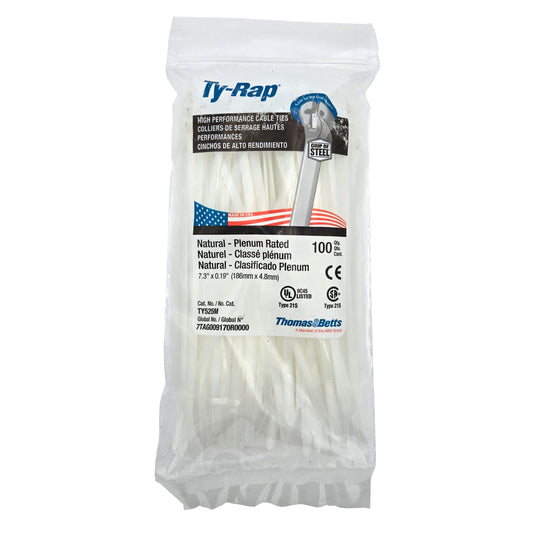
Thomas & Betts Ty-Rap Cable Ties for Aircraft Wiring
Shop Thomas & Betts Ty-Rap cable ties at Pilots HQ for dependable wire bundling, cable organization, and electrical maintenance applications. Now part of ABB Installation Products, the Thomas & Betts brand is known for Ty-Rap cable ties originally developed to simplify the bundling of complex aircraft wiring. The Pilots HQ collection focuses on nylon Ty-Rap cable ties offered in multiple lengths, tensile strengths, bundle capacities, and package quantities for aviation shops, maintenance facilities, and other professional wiring applications.
Thomas & Betts Products Available at Pilots HQ
- Ty-Rap nylon cable ties
- 30-pound tensile-strength cable ties
- 50-pound tensile-strength cable ties
- 120-pound heavy-duty cable ties
- Multiple lengths and bundle diameters
- Bulk packages for maintenance and installation work
Ty-Rap Cable Management Products
Thomas & Betts Ty-Rap cable ties provide a practical method for grouping and organizing electrical wire bundles. Depending on the selected part number, products in the Pilots HQ collection are available in different lengths, widths, tensile ratings, and package quantities. This allows technicians and installers to choose a tie that suits the size of the wire bundle and the mechanical demands of the installation.
Ty-Rap ties feature a stainless-steel locking barb that secures the strap without relying on molded locking teeth. The smooth, notchless strap provides multiple locking positions, allowing the tie to conform closely to the bundle diameter. Ribbed and textured surfaces help grip the wire bundle, while the low-profile head and rounded edges are designed to reduce snagging and limit contact with adjacent conductors.
Key Features and Benefits
- Stainless-steel locking barb provides secure retention.
- Notchless strap allows precise bundle adjustment.
- Rounded edges help protect adjacent wire insulation.
- Low-profile head reduces bulk around wire bundles.
- Multiple tensile strengths support light- and heavy-duty applications.
- Bulk package quantities suit repeated maintenance tasks.
Aircraft Wire Bundling and Organization
Organized wiring helps technicians inspect, trace, service, and troubleshoot aircraft electrical systems. Cable ties may be used to group compatible wires, maintain orderly routing, and support clean workmanship when permitted by the applicable aircraft documentation. They can also help organize wiring on maintenance benches, service carts, test equipment, and non-aircraft electrical assemblies.
Cable ties should not be used as substitutes for approved clamps, stand-offs, lacing, conduit, or other required support hardware. Aircraft wiring installations are subject to vibration, heat, fluids, movement, abrasion, and environmental exposure. The selected securing method must be appropriate for the location and must not place excessive pressure on wire insulation or create an unsupported bundle.
Selecting the Correct Ty-Rap Cable Tie
Before ordering, compare the tie length, width, maximum bundle diameter, tensile strength, material, operating temperature, and package quantity. A shorter light-duty tie may be suitable for a small bundle, while a longer or higher-strength tie may be required for larger cable groups or demanding non-aircraft applications.
- Verify the required tie length and bundle capacity.
- Choose an appropriate tensile-strength rating.
- Confirm temperature and environmental requirements.
- Check compatibility with nearby fluids and materials.
- Select the correct package quantity for the project.
- Confirm the part number before ordering.
Installation and Inspection Considerations
Install cable ties with sufficient tension to retain the bundle without crushing insulation, deforming conductors, or restricting movement required by the installation. Trim excess strap material cleanly and inspect the cut end to ensure it does not create a sharp edge near wiring, hoses, controls, or maintenance access areas.
During routine inspections, examine installed ties for brittleness, cracking, discoloration, looseness, heat damage, chemical exposure, or contact with sharp structure. Replace damaged or deteriorated ties using an appropriate part and approved installation procedure. Wiring should also be checked for chafing, inadequate clearance, excessive bundle tension, and unsupported movement.
Verify Aircraft Installation Requirements
Before using a Thomas & Betts Ty-Rap cable tie on an aircraft, review the applicable wiring diagram, illustrated parts catalog, aircraft maintenance manual, standard practices manual, and any relevant service instructions. Confirm that cable ties are permitted in the installation and verify the specified material, spacing, support method, temperature capability, and environmental requirements. Product availability at Pilots HQ does not establish approval for every aircraft or wiring location.
Shop Thomas & Betts Ty-Rap Cable Ties at Pilots HQ
The Pilots HQ Thomas & Betts collection is focused on Ty-Rap nylon cable ties for wire bundling and cable management. Available options include different lengths, tensile strengths, bundle capacities, and bulk package quantities suitable for aviation maintenance shops and professional electrical work. This collection does not represent ABB’s broader catalog of automation systems, conduit, terminals, electrical enclosures, or industrial equipment.
Browse Thomas & Betts Ty-Rap cable ties at Pilots HQ and compare each product’s dimensions, tensile rating, material, temperature range, package quantity, and part number before purchase. For aircraft installations, always verify the approved securing method and replacement requirements in the current aircraft maintenance documentation.